Checkers — known as draughts through most of the world — is a two-player strategy game played on an 8×8 board. The rules take a few minutes to learn, which is exactly why it has stayed popular for centuries. This guide covers everything: how to set up the board, how the pieces move, how capturing works, how a piece becomes a king, and how the game is won. By the end you'll know every rule that matters, and you can put it straight into practice in a game on the homepage.
What is checkers?
Checkers is a two-player game where each side tries to capture all of the opponent's pieces — or trap them so they have no legal move. You move diagonally, capture by jumping, and crown your pieces into kings when they reach the far side. It's a complete game of skill: no dice, no hidden information, just the position in front of you.
How do you set up a checkers board?
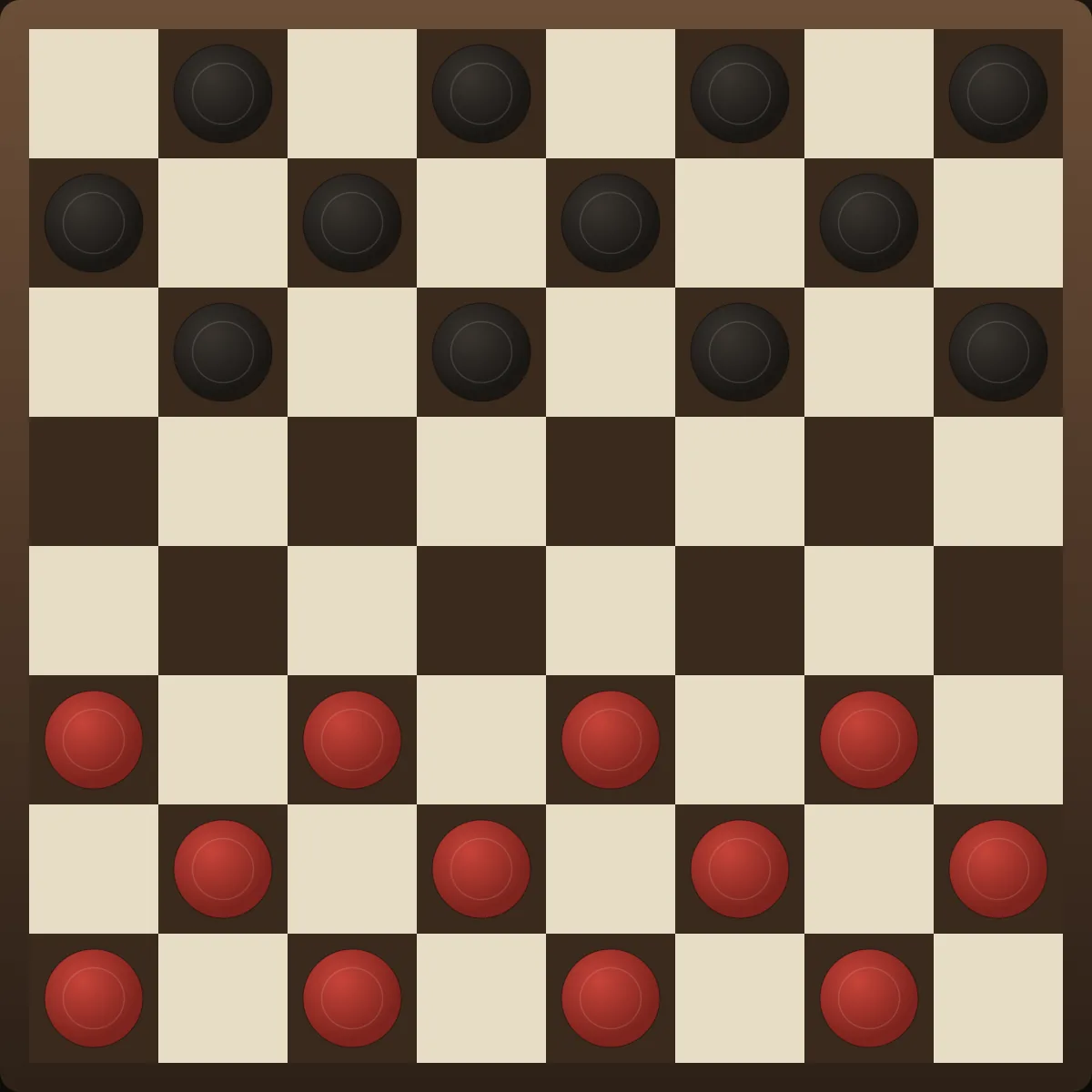
Each player starts with 12 pieces placed on the dark squares of the three rows closest to them. The board is 8×8 with alternating light and dark squares, and all play happens on the 32 dark squares — the light squares are never used. Sit the board so each player has a dark square on their near-left corner. One player takes the dark pieces, the other the light; the darker side traditionally moves first.
How do the pieces move?
Regular pieces move one square diagonally forward, onto an empty dark square. They cannot move straight, sideways, or backward, and they can't land on a square that's already occupied. Forward means toward the opponent's side of the board. That single rule — diagonal, forward, one square — is the whole of basic movement until a piece is captured or crowned.
How do you capture (jump) in checkers?
You capture an opponent's piece by jumping diagonally over it into the empty square directly beyond, then removing the jumped piece from the board. The square you land on must be empty, and the piece you jump must be directly adjacent on the diagonal. Captures are how the game is won, so they're the heart of every plan.
Is capturing mandatory?
Yes. If a capture is available on your turn, you must take it. This "forced capture" rule is what gives checkers its tactical edge: a skilled player can deliberately offer a piece, knowing you're obligated to take it — and walk you straight into a worse position. You can't simply decline a jump to play it safe.
Can you double or triple jump?
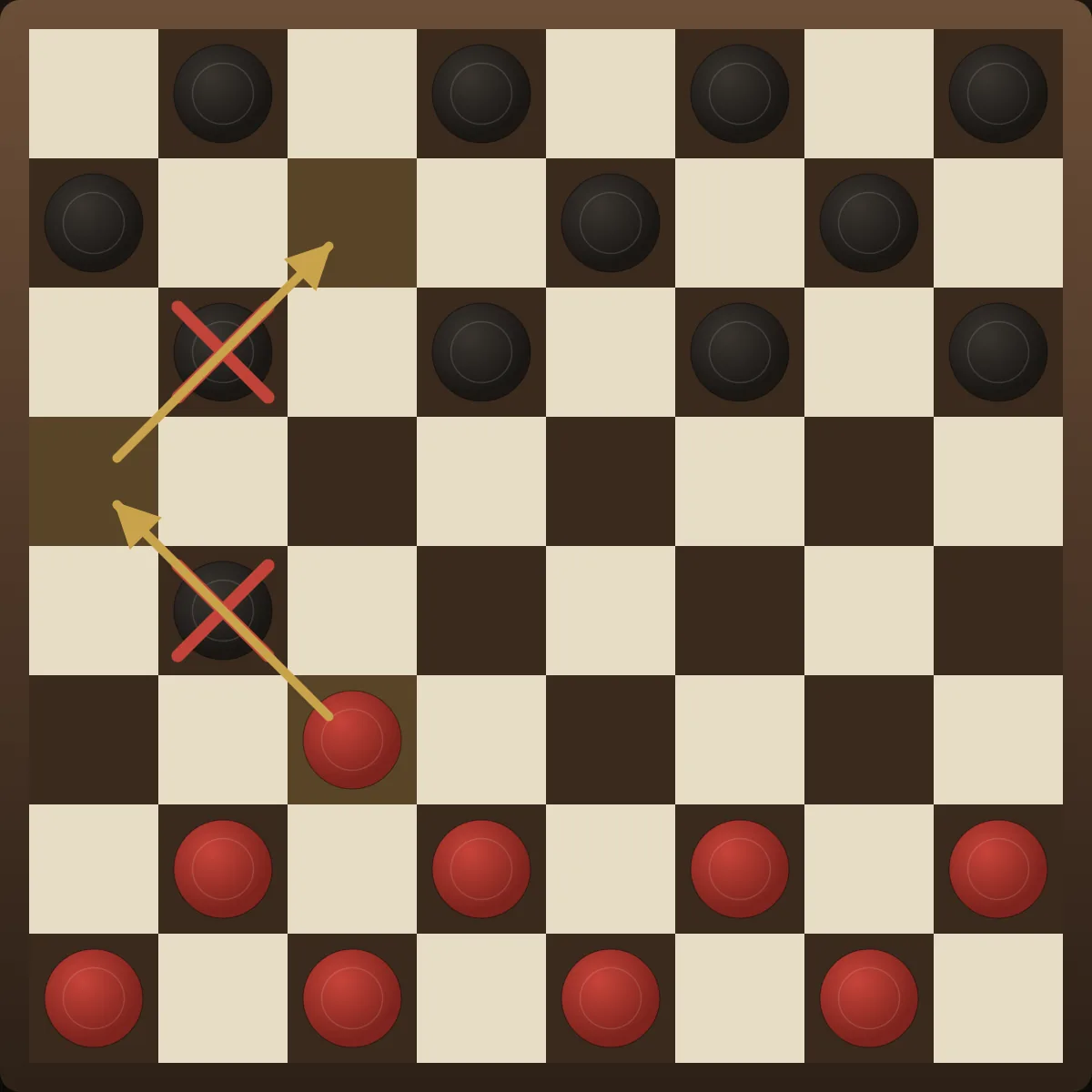
Yes, and multi-jumps are mandatory too. After a jump, if the same piece can immediately jump again, it must continue — capturing two, three, or more pieces in a single turn, zig-zagging across the board. Multi-jumps are the most powerful (and most satisfying) moves in checkers, and setting them up is the core of good tactics.
Can you jump your own pieces?
No. You can never jump over your own pieces, in any direction — only an opponent's piece, into the empty square beyond it.
How does a piece become a king?
When one of your pieces reaches the far row — the opponent's back row, also called the king's row — it is immediately crowned a king (in physical play, a captured piece is stacked on top to mark it). If a piece reaches the king's row in the middle of a multi-jump, it stops there and is crowned; it does not keep jumping that turn.
What can a king do?
A king moves and jumps diagonally both forward and backward, one square at a time in standard American checkers. Within a single multi-jump, a king can combine forward and backward jumps. That backward freedom makes kings far more dangerous than regular pieces — getting the first king is often a turning point in the game.
Can you move backwards in checkers?
Regular pieces cannot move or jump backward in American/English checkers — only kings can. (This is one of the most-searched rules questions, and the answer differs by variant: in International and Russian draughts, regular pieces are allowed to capture backward. On this site, standard checkers follows the American rule: men forward only, kings both ways.)
How do you win at checkers?
You win by capturing all of your opponent's pieces, or by leaving them with no legal move on their turn — for example, by blocking in their remaining pieces. There is no stalemate in checkers as there is in chess: a player who cannot move simply loses. Games between very even players can end in a draw, typically when neither side can make progress.
A quick example turn
Say it's your move and one of your pieces sits diagonally next to an opponent's piece, with the square just beyond it empty. The forced-capture rule means you must jump: you hop over their piece, land on the empty square, and remove theirs from the board. If your piece now sits next to another of theirs with an empty square beyond, you must jump again — and that's a double jump in a single turn.
The variants, in one line each
Standard "checkers" is the 8×8 American game described above, but it's one of a family. International draughts is played on a 10×10 board with 20 pieces a side, flying kings, and backward captures for regular pieces. Brazilian and Russian checkers use the 8×8 board with international-style king rules. Canadian draughts goes bigger still on a 12×12 board. Chinese checkers is a different game entirely — a star-shaped board where you race marbles across, with no capturing. Each gets its own full guide on the site, and the Variants hub maps them all.
Where to go next
Now that you know the rules, the fastest way to improve is to learn how to think a move ahead. Read the Checkers Strategy guide for openings, the two-for-one shot, and endgame tips — then put it to work in a game.