Setting up a checkers board takes about thirty seconds once you know the three things that matter: which way the board goes, which squares the pieces sit on, and how many pieces each player gets. This guide walks through it step by step, then answers the questions people get stuck on.
How do you set up a checkers board?
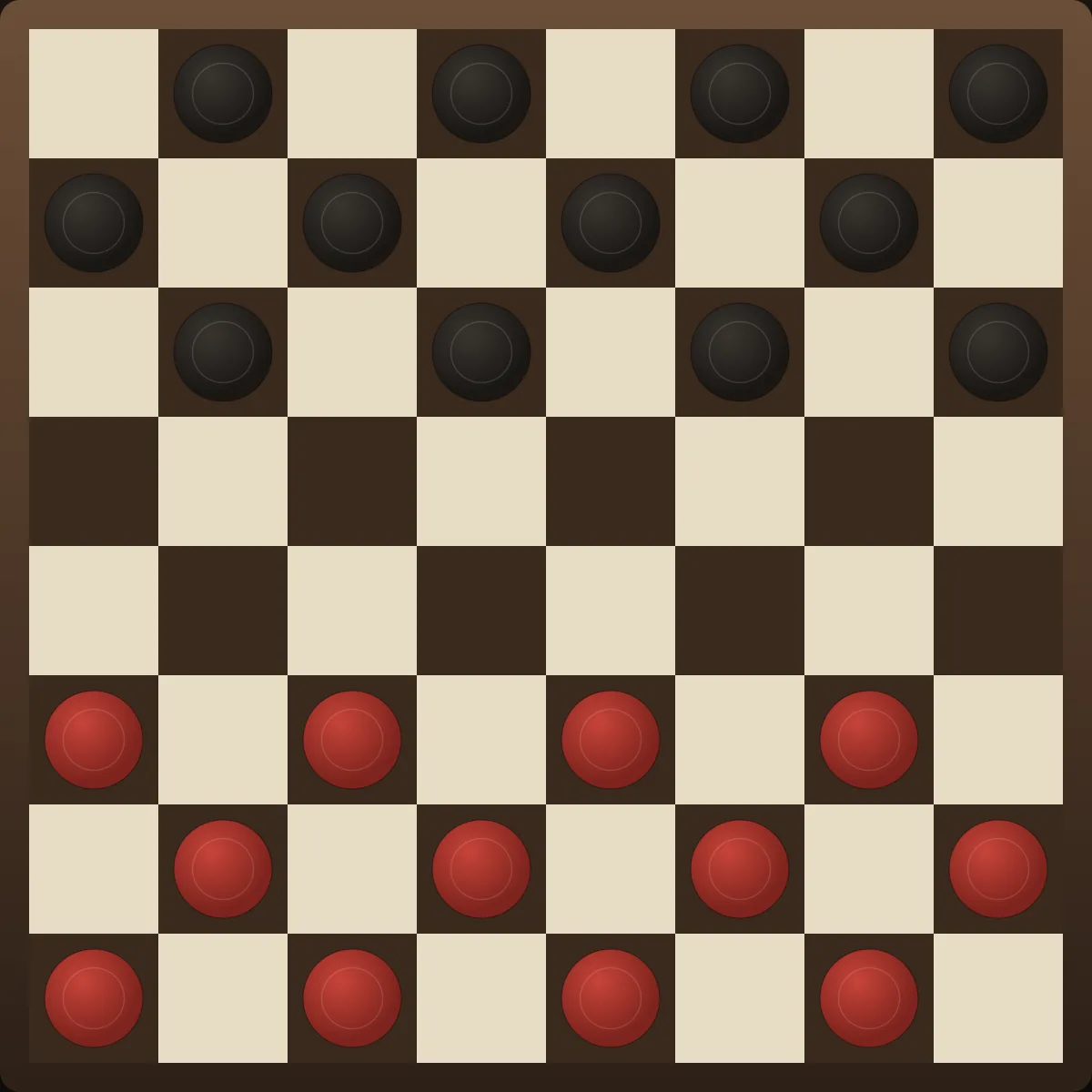
Place 12 pieces for each player on the dark squares of the three rows closest to that player. The board is 8×8 — 64 squares in alternating light and dark — and all play happens on the 32 dark squares. Set the board so each player has a light square in their near-right corner, give one player the dark pieces and the other the light, and fill the three near rows of dark squares. That's it.
Which way does the board go?
Orient the board so that each player has a light (the lighter-colored) square in the bottom-right corner — the classic "light on right" rule. Because checkers is played entirely on the dark squares, getting the orientation right ensures the dark squares line up correctly for both players. If your near-right corner is dark, rotate the board a quarter turn.
Which squares do the pieces go on?
Pieces only ever sit on the dark squares — the light squares are never used in standard checkers. Each player fills the dark squares in the three rows nearest them, leaving the two middle rows empty. With a standard 8×8 board, that's four dark squares per row across three rows: 12 pieces per side, 24 on the board, and 8 empty dark squares in the middle separating the two armies.
How many pieces does each player get?
Each player starts with 12 pieces. They're identical at the start — all "men" — and become kings only later, by reaching the far side of the board. One player's set is dark, the other's light; in physical sets these are usually red/black or black/white.
Who moves first in checkers?
The player with the dark pieces moves first, then play alternates. (Some casual sets reverse this; the important thing is to agree before you start.) The opening move is always a single piece sliding one square diagonally forward into the empty middle of the board.
A quick step-by-step
- Orient the board: light square in each player's near-right corner.
- Choose colors: one player takes the dark pieces, the other the light.
- Fill your three near rows: place a piece on every dark square in the three rows closest to you.
- Confirm the count: 12 pieces each, the two center rows empty.
- Dark moves first — slide one piece diagonally forward to begin.
Setting up the variants
Bigger variants use the same idea on a bigger grid. International draughts fills the dark squares of the first four rows with 20 pieces per side on a 10×10 board; Canadian draughts uses 30 pieces a side on a 12×12 board. Turkish checkers is the odd one out — pieces use every square, not just the dark ones, and line up in solid ranks. Each variant guide covers its own setup.
Now play
That's the setup. If you want the full rules — how pieces move, capturing, kinging, and how to win — read the complete How to Play Checkers guide, or just start a game on the home page.